
BECna: very malicious things

More in General
- Open up, that's an order
The PT ESC cyber threat intelligence team has discovered the exploitation of CVE-2026-21513 in attacks on…
- Operation Chewbacca
At the end of June, the PT ESC team, during incident investigations, discovered a new group…
- Ding, ding — who's there?
Ding, ding — who's there? 🔔 The cyber intelligence group of Positive Technologies' expert security center…
- Enterprise-grade validation system with schema support
Enterprise-grade validation system with schema support (c) The author of a dozen trojans who forgot to…
- One less feathered thief — plus one hundred rating points!
One less feathered thief — plus one hundred rating points! 😵 The Threat Intelligence team at…




The PT ESC Threat Intelligence team has recorded mass BEC attacks against Russia using the BoryptGrab stealer. In March 2026, researchers publicly described this stealer, and just two months later our team recorded attacks on Russian organizations.
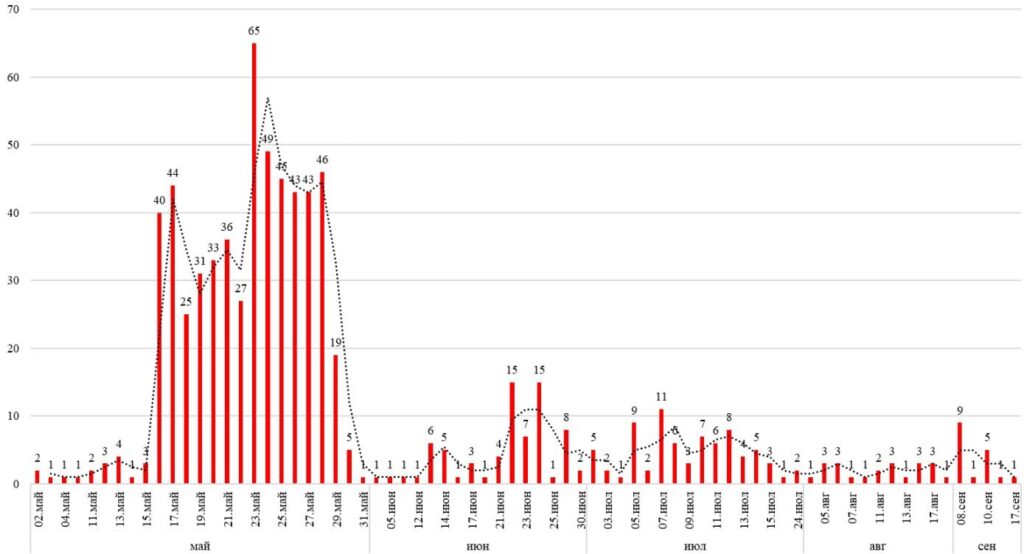
The peak of attacks occurred in early July, but new samples associated with attacks on Russian organizations continue to appear to this day, and the number of victims in Russia exceeds 1,200. The attacks are the work of a threat actor we have named VecnaHopper.
Initial vector 😨
The initial vector was phishing emails that the threat actor sent en masse to various corporate mailboxes (in some cases more than 100 simultaneous recipients of copies of the email). An example of such an email:
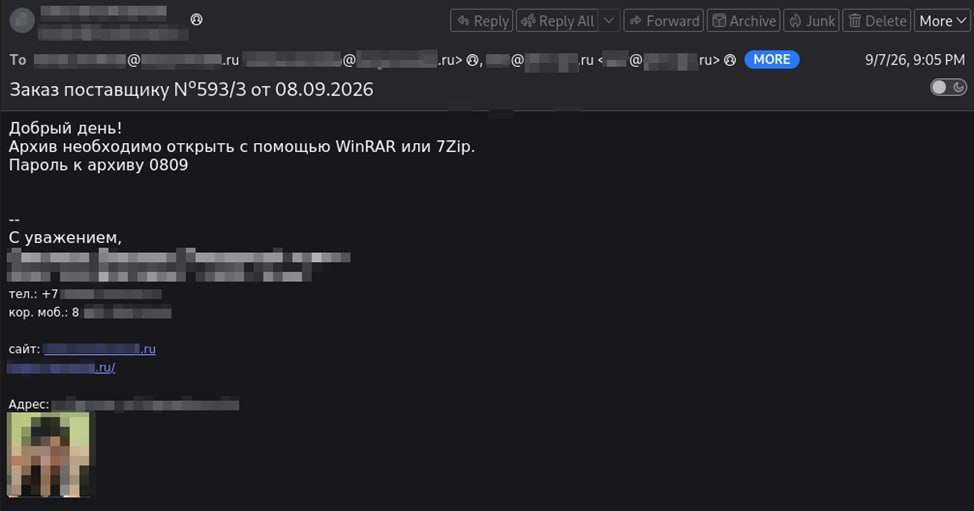
All the email addresses discovered that were used by the attacker to distribute the stealer are compromised credentials of Russian citizens who are in some way connected to individual entrepreneurial activity.
In at least one case, we observed how the threat actor, using mailbox A, sent phishing emails on July 2 to several mailboxes, including mailbox B. And on July 10, from the compromised mailbox B, the threat actor carried out a new attack. Because of this characteristic, we named the threat actor VecnaHopper.
Scale and victimology 👮♂️
Over the entire observation period, we identified at least five mass waves of cyberattacks. In reality, there were more waves, since the first samples of BoryptGrab used in cyberattacks on Russian organizations were discovered in May 2026.
However, we were able to reliably identify the email addresses used for malicious distribution and the targeted organizations in only five cases:
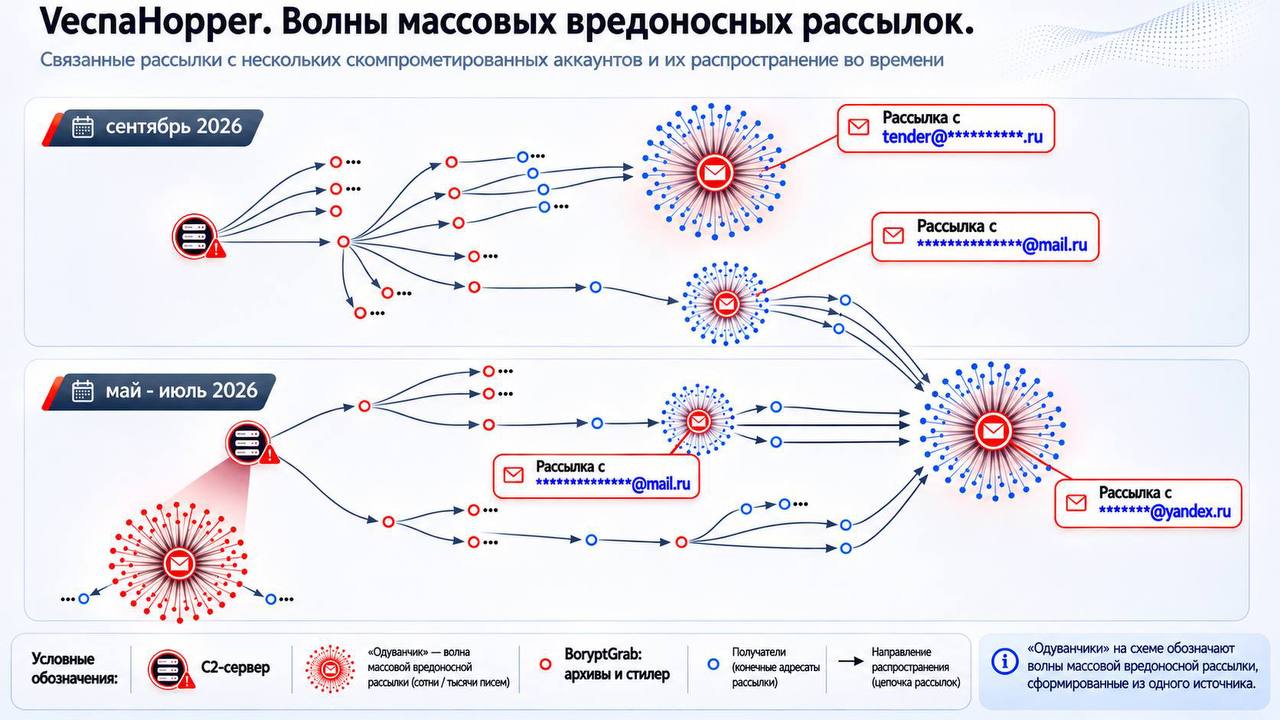
The attacker does not select any particular types of organizations — the picture is rather random and chaotic. Most likely, this is due to automated BEC attacks: the fraudsters simply take all contacts from the correspondence of previous victims and send emails further.
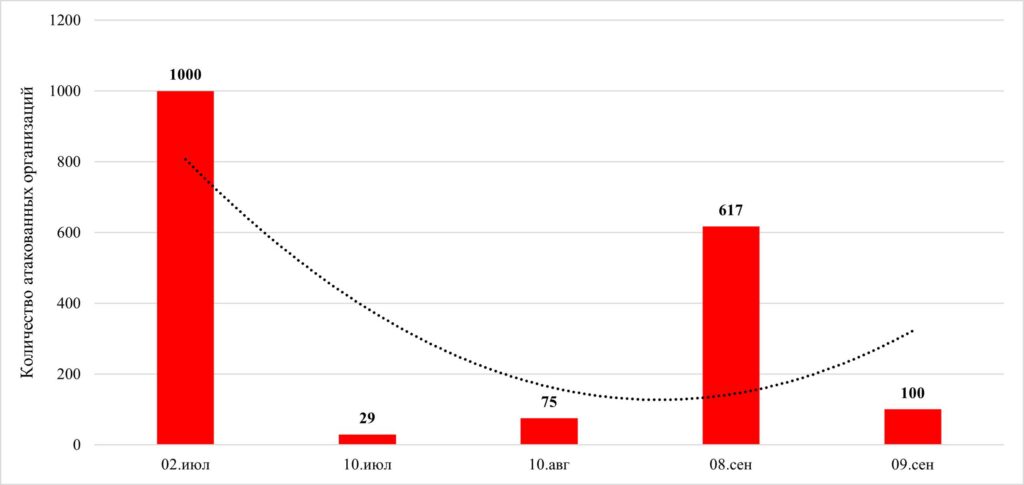
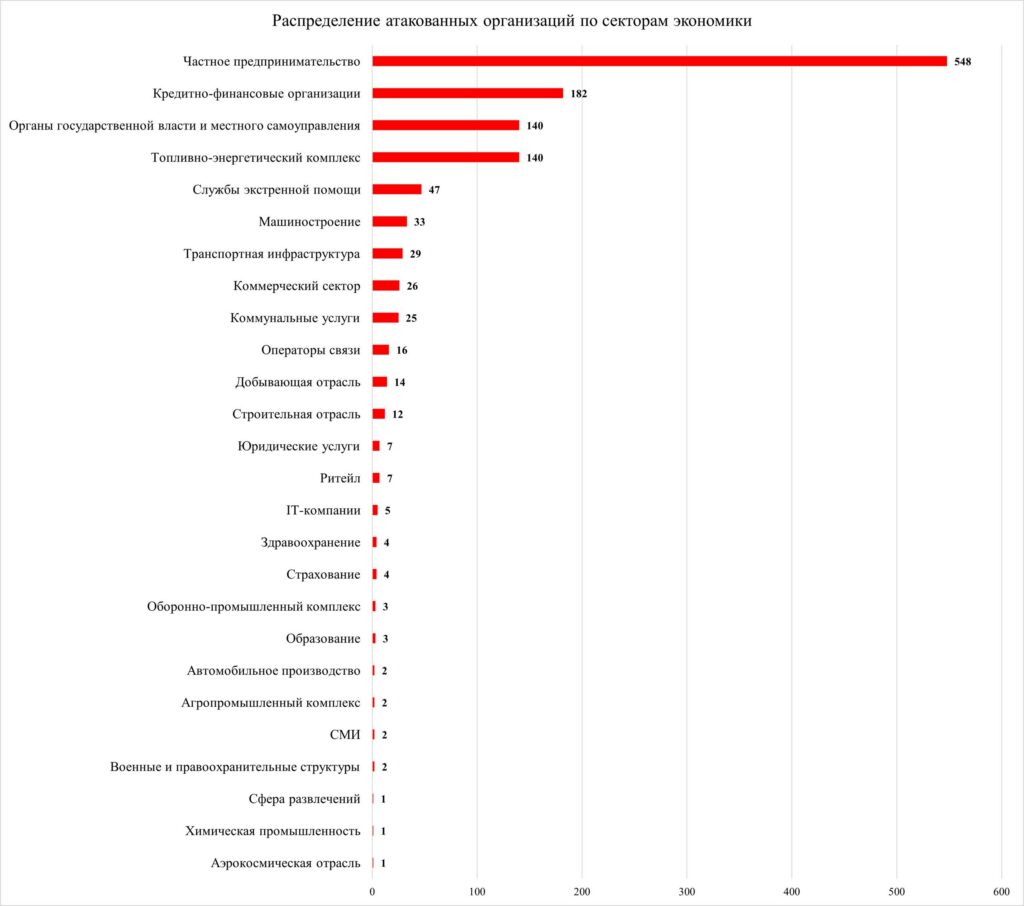
Over five months (from May to September 2026), we were able to reliably record 1,256 attacked Russian companies and organizations. Almost half of them are individual entrepreneurs (44%). Among the rest, banks and financial organizations are the most common (14%), followed by companies from the fuel and energy sector (11%) and government authorities (11%).
The overall distribution can be seen in the following chart:
In VecnaHopper‘s arsenal, more than 700 samples of the BoryptGrab stealer linked to the attacker’s C2 infrastructure were discovered. The most active generation of new samples was observed in the second half of May 2026:
Infection chain 👾
The overall infection chain looked as follows:
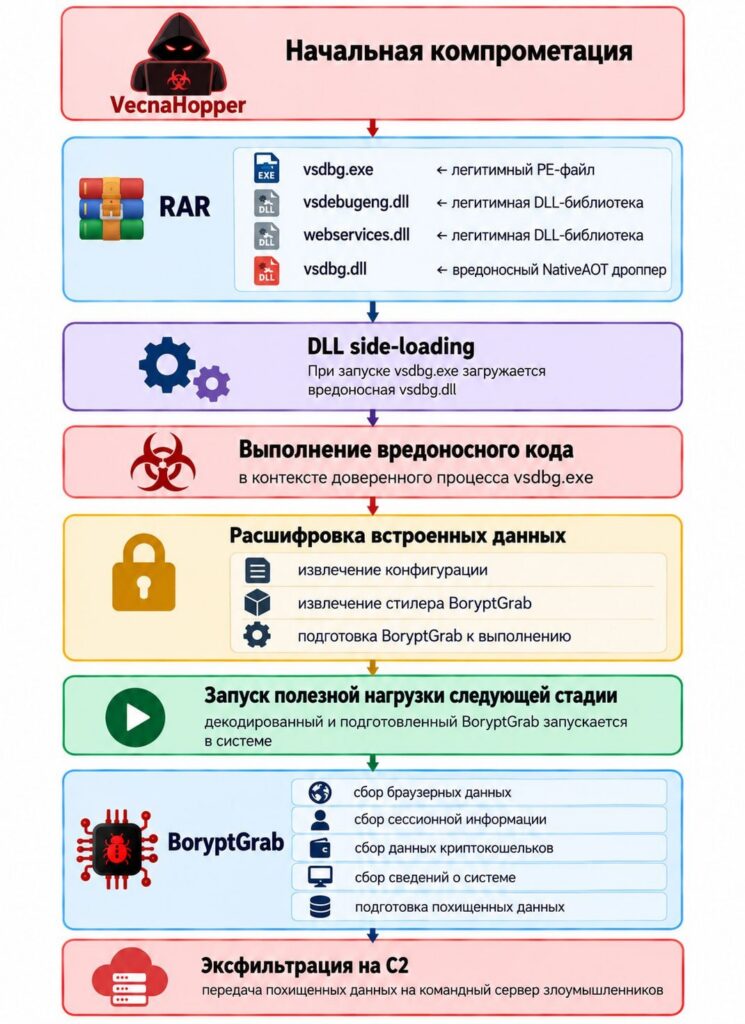
The emails had password-protected archives attached. Inside the archive is a set of executable PE files and DLL libraries:
vsdbg.exevsdbg.dllvsdebugeng.dllwebservices.dll
The archive contains a legitimate vsdbg.exe (the Visual Studio debugger) along with a fake vsdbg.dll. When launched, Windows picks up this library — classic DLL side-loading.
vsdbg.dll is a 64-bit NativeAOT dropper written in C#. It decrypts and launches the next stage. Inside there is usually encrypted data, fake PE metadata, and a bunch of empty exports to confuse analysis.
The dropper’s functionality consisted of decrypting the config and payload, allocating memory, creating a thread, and transferring control to the next component.
The final payload is the BoryptGrab stealer. It collects logins, passwords, cookies, and sessions from browsers (more than 19, including Amigo and QQBrowser), data from Telegram, Discord, Steam, crypto wallets, secrets from Windows Credential Manager, as well as files from the desktop and the Documents folder by extensions and keywords — password, wallet, seeds, etc. The stealer also takes screenshots and collects system information such as the computer name, IP, and installed programs.
A separate feature is the bypass of Chrome App-Bound Encryption via injection into the browser process. It uses the SHA-1 of the desktop wallpaper as a machine identifier (possibly to filter out sandboxes). There is no persistence in the system.
The collected data is stored in the temporary folder %TEMP%\[country]_[IP]_[date]_[GUID]\, inside which is a directory with browser data and several text files. Everything is packed into a ZIP and sent via a POST request to [C2]:[PORT]/upload. The result of the upload is written to %TEMP%\sends.log.
Network indicators 🔦
C2 infrastructure
2.26.126.50
37.77.150.162
45.74.7.176
91.210.146.50
94.183.168.16
193.143.1.131
titatitato.net
Directory and file names
%TEMP%\[COUNTRY]_[IP]_[DATE]_[GUID]\
%TEMP%\[COUNTRY]_[IP]_[DATE]_[GUID]\decrypt_browser\
UserInformation.txt
installed_applications.txt
browser_decryption.log
%TEMP%\sends.log
Names of malicious RAR archives
Информационное письмо от 08.09.2026.rar
Заказ от 08.09.2026.rar
Заказ поставщику №593_3 от 08.09.2026.rar
Запрос от 05.08.2026.rar
Запрос от 06.08.2026.rar
Запрос от 09.08.2026.rar
Запрос от 19.08.2026.rar
Запрос от 20.08.2026.rar
Запрос от 23.08.2026.rar
Запрос от 09.09.2026.rar
Запрос от 29.09.2026.rar
Приказ от 05.07.2026.rar
Уведомление от 10.07.2026.rar
Уведомление от 05.08.2026.rar
Уведомление №43 от 10.08.2026.rar
Уведомление от 19.08.2026.rar
Уведомление от 20.08.2026.rar
Уведомление от 23.08.2026.rar
Уведомление от 02.09.2026.rar
ФИНРАСПЛАТ.rar
MATERIALS ДЕЛА.rar
ДОПОЛНЕНИЕ 1.rar
#TI #APT #Malware #Phishing #IoCs
@ptescalator
More from ti_author
- Open up, that's an order
The PT ESC cyber threat intelligence team has discovered the exploitation of CVE-2026-21513 in attacks on…
- Ding, ding — who's there?
Ding, ding — who's there? 🔔 The cyber intelligence group of Positive Technologies' expert security center…
- Enterprise-grade validation system with schema support
Enterprise-grade validation system with schema support (c) The author of a dozen trojans who forgot to…
- One less feathered thief — plus one hundred rating points!
One less feathered thief — plus one hundred rating points! 😵 The Threat Intelligence team at…
- DragonDoll: a matryoshka in the world of Android spies
DragonDoll: a matryoshka in the world of Android spies 🪆 At the beginning of this spring,…

More in General
- Open up, that's an order
The PT ESC cyber threat intelligence team has discovered the exploitation of CVE-2026-21513 in attacks on…
- Operation Chewbacca
At the end of June, the PT ESC team, during incident investigations, discovered a new group…
- Ding, ding — who's there?
Ding, ding — who's there? 🔔 The cyber intelligence group of Positive Technologies' expert security center…
- Enterprise-grade validation system with schema support
Enterprise-grade validation system with schema support (c) The author of a dozen trojans who forgot to…
- One less feathered thief — plus one hundred rating points!
One less feathered thief — plus one hundred rating points! 😵 The Threat Intelligence team at…