
Open up, that's an order
More in General
- BECna: very malicious things
The PT ESC Threat Intelligence team has recorded mass BEC attacks against Russia using the BoryptGrab…
- Operation Chewbacca
At the end of June, the PT ESC team, during incident investigations, discovered a new group…
- Ding, ding — who's there?
Ding, ding — who's there? 🔔 The cyber intelligence group of Positive Technologies' expert security center…
- Enterprise-grade validation system with schema support
Enterprise-grade validation system with schema support (c) The author of a dozen trojans who forgot to…
- One less feathered thief — plus one hundred rating points!
One less feathered thief — plus one hundred rating points! 😵 The Threat Intelligence team at…




The PT ESC cyber threat intelligence team has discovered the exploitation of CVE-2026-21513 in attacks on Russian organizations. The initial link in the chain was a DOCX document titled “2026 Приказ от 08.10.2026 25-118ап.docx,” disguised as an official order. Analysis of the file and related components made it possible to reconstruct the delivery chain of a JScript backdoor.
How the chain begins
The address of the next document is stored inside the DOCX, in word/_rels/webSettings.xml.rels. The link points to cloudpostmail.net. Word contacts the server when processing the external frame and receives a file with a DOC extension, which by its content turns out to be RTF.

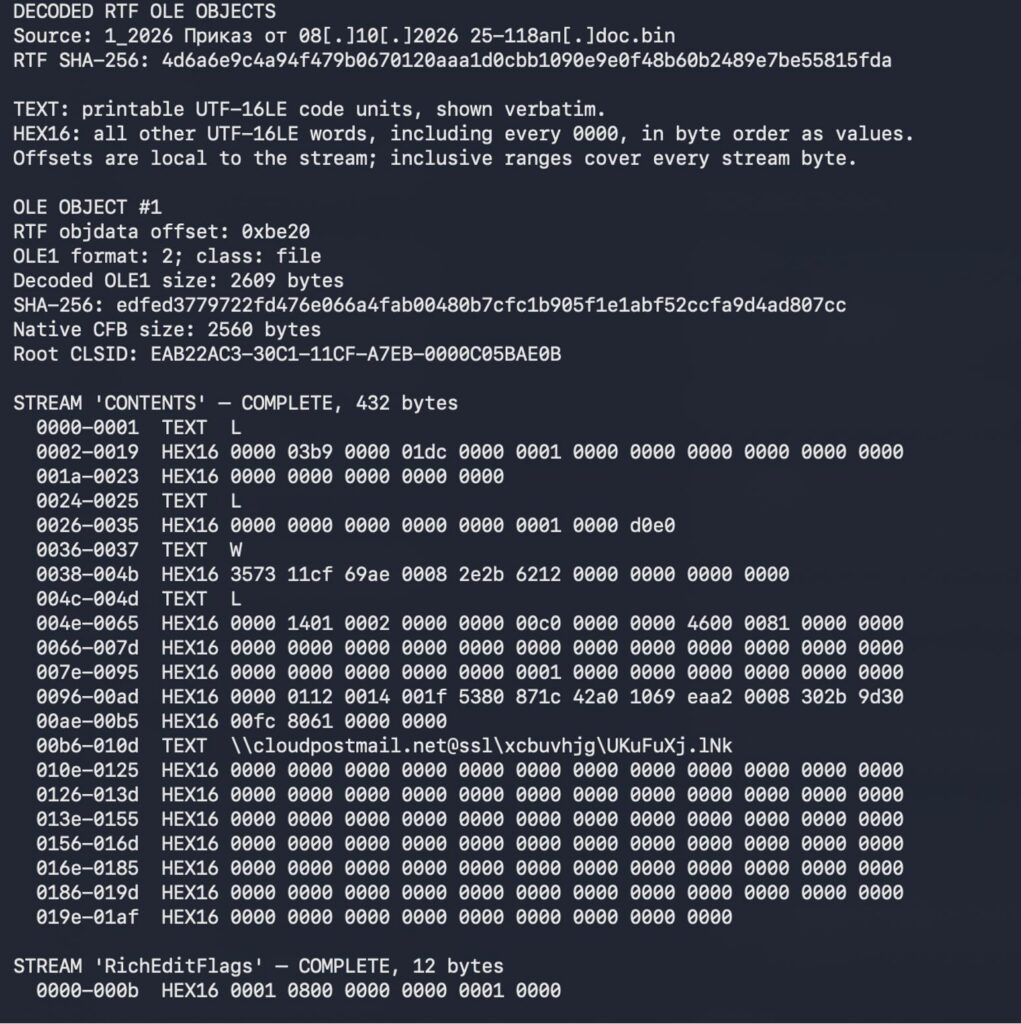
The RTF contains two OLE objects of the Shell.Explorer.1 component with the CLSID EAB22AC3-30C1-11CF-A7EB-0000C05BAE0B. In the CONTENTS stream of both objects, links to the remote shortcut UKuFuXj.lNk are saved. The first object is shown in the screenshot below. One of the addresses:
\\cloudpostmail.net@ssl\xcbuvhjg\UKuFuXj.lNkThe @ssl marker specifies access via WebDAV over HTTPS. Such a path is handled by the WebClient service.
What the shortcut hides
UKuFuXj.lNk combines a Windows shortcut and HTML with a script. The binary part points to the remote DLL eNlJ.d, while the HTML contains exploit code for CVE-2026-21513. It begins at offset 0xde, that is, after the first 222 bytes of the file.
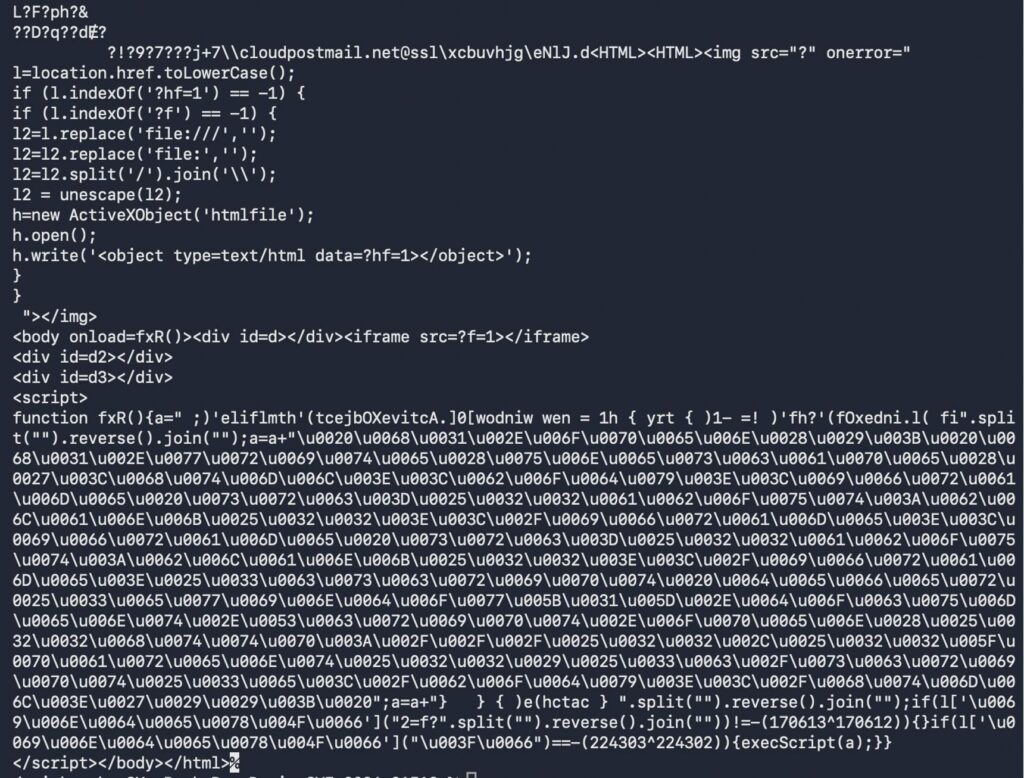
CVE-2026-21513 affects MSHTML — the Windows component for processing HTML, which is also used in embedded elements of Word. An address validation error when following a link allows bypassing security restrictions for content from the internet and passing file execution to the Windows shell. As a result, specially crafted HTML can lead to code execution outside the intended browser context.
In this chain, the HTML inside the shortcut creates nested frames and triggers the vulnerable link-following mechanism. On successful exploitation, this allows transitioning from HTML processing to launching the LNK and downloading the library eNlJ.d specified in it.
To complicate analysis, the attackers wrote some strings in reverse order and another part as Unicode character codes. The script reconstructs instructions from them and executes them via execScript. Below is the decoded fragment that triggers the vulnerable mechanism.
Decoded HTML from the shortcut
<html>
<body>
<iframe src="about:blank">
</iframe>
<iframe src="about:blank">
</iframe>
<script defer>window[1].document.Script.open("http:///","_parent")</script>
</body>
</html>
How the backdoor is installed
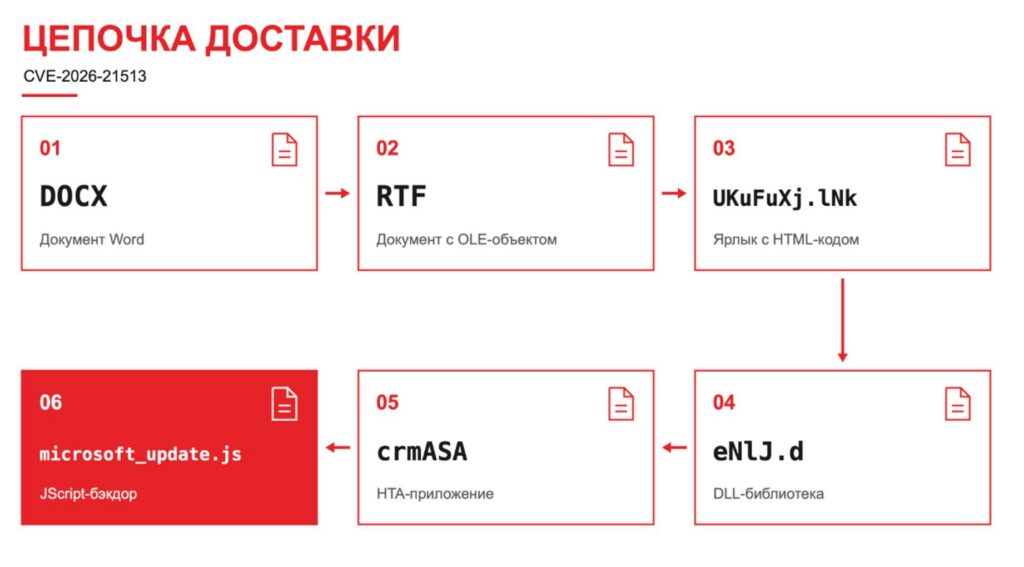
eNlJ.d is a malicious DLL library that serves as an intermediate loader: when loaded, it launches the system utility mshta.exe and passes it the address crmASA on cloudpostmail.net.
crmASA is a malicious HTA file that works as a backdoor installer: it downloads the resource IiVe, decodes its contents from Base64, and saves the resulting JScript to the path:
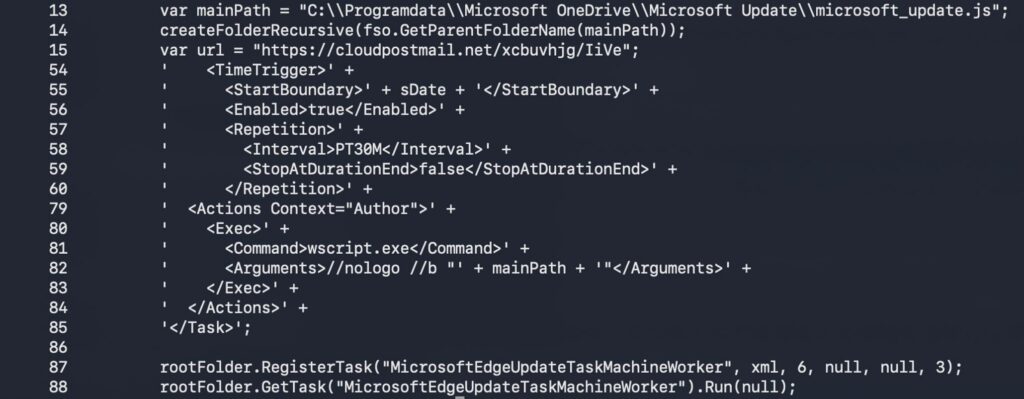
C:\ProgramData\Microsoft OneDrive\Microsoft Update\microsoft_update.jsPersistence is handled by the same HTA installer. It creates the task MicrosoftEdgeUpdateTaskMachineWorker, which launches the saved microsoft_update.js via the standard Windows script host wscript.exe. The HTA immediately runs the task and configures it to re-run every 30 minutes. The JS backdoor itself does not create the task.
What the operator gets
Each time microsoft_update.js runs, it sends the username, computer name, and domain to supportxml.org/xcbuvhjg/WkbE. This information allows the operator to distinguish infected devices and determine which account and domain the script is running from.
The backdoor then requests JScript code from the server, decodes the Base64 response, and executes it via eval inside the wscript.exe process. This way the operator can change tasks without replacing the backdoor itself. The received code runs with the privileges of the user under whose name the script was launched.
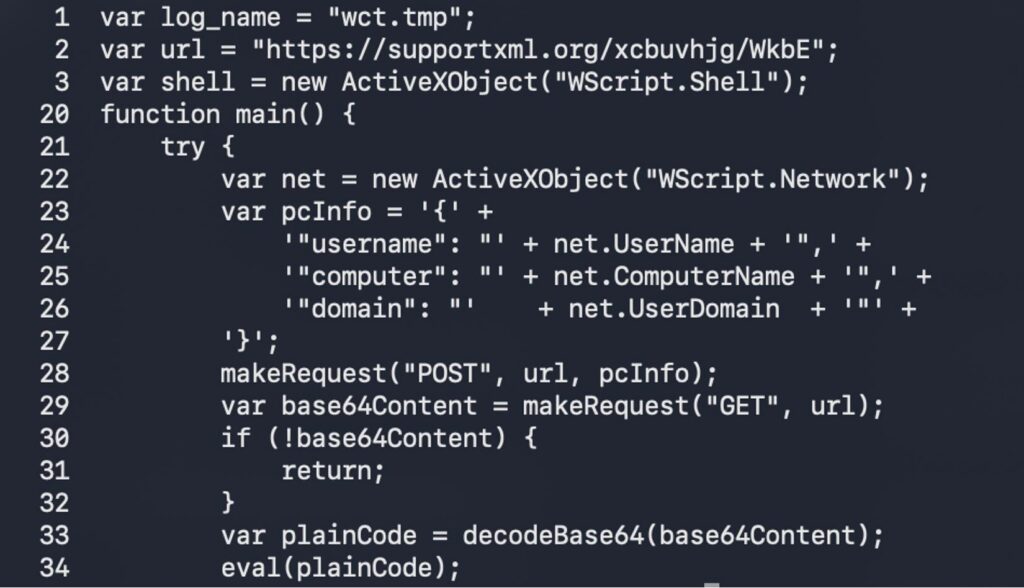
The backdoor has no persistent server polling loop: the repeated launch every 30 minutes is provided by a scheduled task created by the HTA installer.
Additional WkbE scenario
From the address supportxml.org/xcbuvhjg/WkbE, we were able to obtain an additional payload — a JScript scenario encoded in Base64. The backdoor decodes it and executes it in the memory of the wscript.exe process, without saving the scenario itself as a separate file on disk.
The payload performs system reconnaissance: it collects information about the OS and installed updates, running processes, programs, users and groups, network settings, and connections. This data allows the operator to study the infected computer and its network environment in order to prepare further actions.
Before collecting, the scenario attempts to clear the Office and IE file caches, which may delete traces of delivery stored there. The results of system commands are temporarily written to %TEMP%\temp.txt. The scenario then reads this file, deletes it, and sends the collected information to the same server.
Where to look for traces
- In network telemetry:
Word/WebClientrequests tocloudpostmail.net, including the WebDAV methodsOPTIONS,PROPFIND, andLOCK. - On endpoint devices: the specified path
microsoft_update.js, the taskMicrosoftEdgeUpdateTaskMachineWorker, launches ofmshta.exewith an external URL. - In the backdoor’s network activity:
POSTandGETrequests tosupportxml.org/xcbuvhjg/WkbE.
How to reduce the risk
Install Windows security updates for February 2026 or later. Additionally, it is worth checking the listed artifacts and network requests: installing updates does not remove an already installed backdoor.
IoCs
Delivery server:
cloudpostmail.netRecorded IP of the delivery server:
77.232.38.172Command server:
supportxml.org/xcbuvhjg/WkbE
SHA-256:
DOCX: 3e3e4ab49ef879ecdd424f24b5638666deb79b767d140a00cf47b58a6ad479aa
RTF: 4d6a6e9c4a94f479b0670120aaa1d0cbb1090e9e0f48b60b2489e7be55815fda
UKuFuXj.lNk: 7154b729333ec22e401b7529fe2c75dd712c03c673f89ff182a5bf36a0f972e0
eNlJ.d — DLL: b7fdf63523250503c93b6c59f6cacfea72c61732f45ff9e2d544789005509f66
crmASA — HTA: 06e9dbe71016f2e447b3106b50afc6646dcc81f365b69b74fef1f3aac79f5610
IiVe — backdoor in Base64: 07efc69553cccbab7c06e2d362315abaffa045ff8904304a14a0c984ddabdfc7
microsoft_update.js — decoded backdoor: f3d9ffcbb8378c71a102ad951ddcba08f42acdceddb9d4cf0205671141671571
WkbE — additional scenario in Base64: f695ed881d71c0103eabc7073c2d81116722c08a83fb27582010a33eeb4a93eb
#TI #Malware #Phishing #IoC
@ptescalator
More from ti_author
- BECna: very malicious things
The PT ESC Threat Intelligence team has recorded mass BEC attacks against Russia using the BoryptGrab…
- Ding, ding — who's there?
Ding, ding — who's there? 🔔 The cyber intelligence group of Positive Technologies' expert security center…
- Enterprise-grade validation system with schema support
Enterprise-grade validation system with schema support (c) The author of a dozen trojans who forgot to…
- One less feathered thief — plus one hundred rating points!
One less feathered thief — plus one hundred rating points! 😵 The Threat Intelligence team at…
- DragonDoll: a matryoshka in the world of Android spies
DragonDoll: a matryoshka in the world of Android spies 🪆 At the beginning of this spring,…

More in General
- BECna: very malicious things
The PT ESC Threat Intelligence team has recorded mass BEC attacks against Russia using the BoryptGrab…
- Operation Chewbacca
At the end of June, the PT ESC team, during incident investigations, discovered a new group…
- Ding, ding — who's there?
Ding, ding — who's there? 🔔 The cyber intelligence group of Positive Technologies' expert security center…
- Enterprise-grade validation system with schema support
Enterprise-grade validation system with schema support (c) The author of a dozen trojans who forgot to…
- One less feathered thief — plus one hundred rating points!
One less feathered thief — plus one hundred rating points! 😵 The Threat Intelligence team at…