
Operation Tartaria Part 2
More in General
- Operation Chewbacca
At the end of June, the PT ESC team, during incident investigations, discovered a new group…
- Ding, ding — who's there?
Ding, ding — who's there? 🔔 The cyber intelligence group of Positive Technologies' expert security center…
- Enterprise-grade validation system with schema support
Enterprise-grade validation system with schema support (c) The author of a dozen trojans who forgot to…
- One less feathered thief — plus one hundred rating points!
One less feathered thief — plus one hundred rating points! 😵 The Threat Intelligence team at…
- DragonDoll: a matryoshka in the world of Android spies
DragonDoll: a matryoshka in the world of Android spies 🪆 At the beginning of this spring,…




In addition to the passive backdoor
PlugX, we managed to discover another version of it that mimicked the launch of Yandex Browser.{"TaskId":"[REDACTED]","TaskName":"Yandexstart_Server","TaskRegistryPath":"\\Yandexstart_Server","TaskAuthor":"[REDACTED]","IsHiddenTask":false,"IsMissingOnFS":true,"Action":{"Context":"Author","Properties":[{"Id":"","ActionName":"Execution","Arguments":"-d restart","Command":"C:\\PROGRA~1\\Yandex\\browser\\Yandex.exe","WorkingDirectory":"","Flags":0}],"Version":3},"Triggers":[{"TriggerType":"Boot","Comment":"Boot"}],"CreatedTime":"2024-12-11T01:11:34Z","LastRunTime":"2025-06-23T06:37:17Z","LastErrorCode":1223,"Timeline":"2024-12-11T01:11:34Z"}
Code language: JSON / JSON with Comments (json)Yandex.exe turned out to be vulnerable to the DLL Side-Loading technique, carried out by the Umdh.exe utility (User-Mode Dump Heap), which loads a malicious dbghelp.dll library under a VMProtect packer with custom section names; the payload is stored in the desktop.ini file.🫣 As in the previous case, we are dealing with a two-module backdoor. The connector is injected into the
choice.exe process, and the command interpreter into mspaint.exe. The processes communicate via the pipe .\\PIPE\\[%d].Upon successful startup, the sample under investigation connects to a blog on
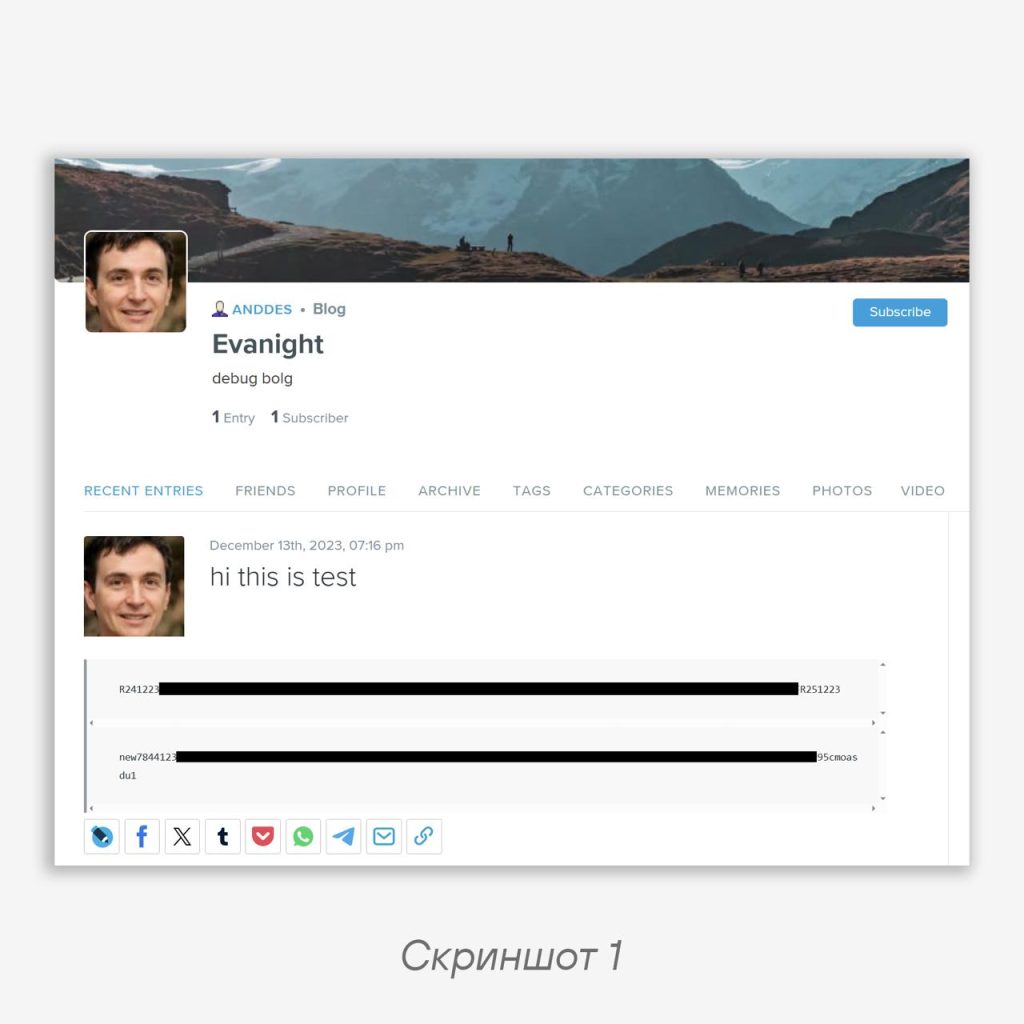
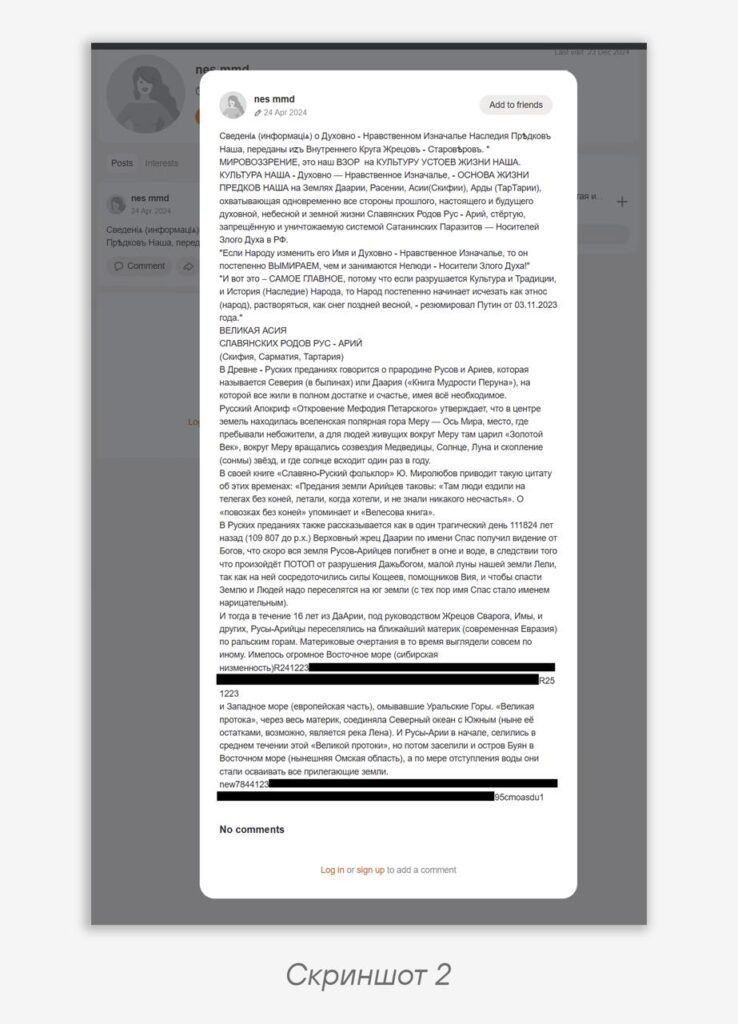
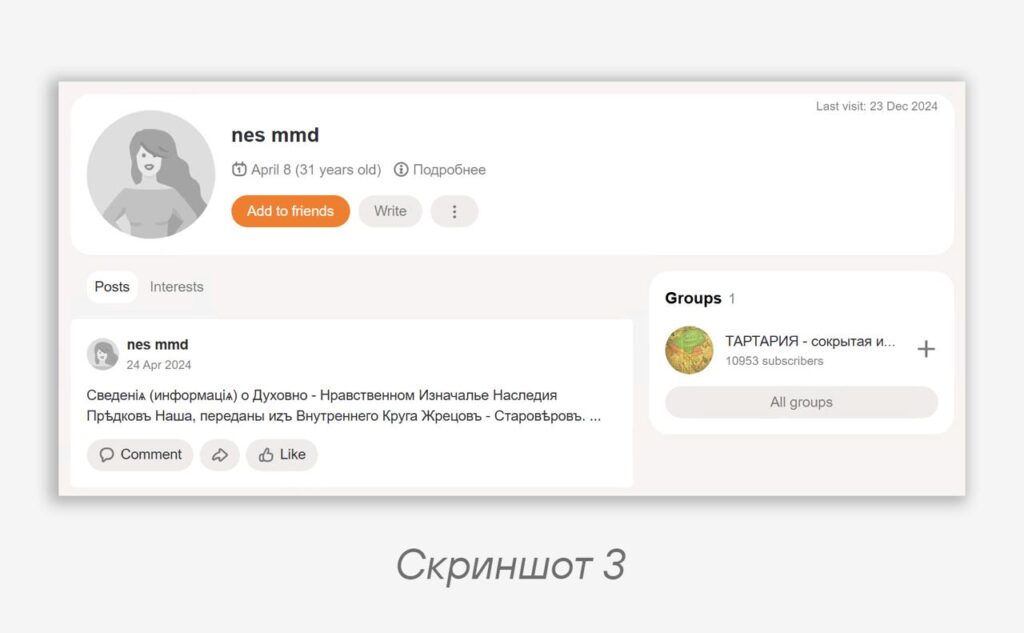
livejournal.com (screenshot 1) and on ok.ru (screenshots 2-3). It then parses the response content and searches for a sequence that begins with R241223 and ends with R251223, and within which an encrypted token for the Yandex Disk API is located. The backdoor then communicates via the API. A similar sample was described in “CloudSorcerer: a new APT threat targeting Russian government organizations.”In addition to Yandex Disk, the backdoor supports communication via Microsoft Graph and Dropbox:
cloud-api.yandex.net
graph.microsoft.com
content.dropboxapi.com
Code language: plaintext (plaintext)
Communication occurs by reading and overwriting files in a specified folder in the cloud. The files themselves are protected by a simple substitution cipher, and the structure of the messages differs depending on the command being executed. However, the same
header is used everywhere:0 2 6 10 14
| command | msg size | short answer | ticketcount |
Code language: plaintext (plaintext)☝️ The following backdoor functions are noteworthy:
• the ability to receive shellcodes and PE files, injecting them into the
TSTheme.exe and msiexec.exe processes;• execution of WMI queries to obtain system information:
SELECT * FROM Win32_OperatingSystem
SELECT * FROM Win32_TimeZone
SELECT * FROM Win32_ComputerSystem
SELECT * FROM Win32_QuickFixEngineering
Code language: SQL (Structured Query Language) (sql)
• disconnection of all network connections via the WNetCancelConnection2W API;
• modification of account logon parameters or password via the NetUserSetInfo API.
C2:
devtunnels.ms
https://anddes.livejournal.com/511.html
https://ok.ru/profile/587950172233/statuses/157023463517001
Code language: YAML (yaml)
✅ Recommendations:
• block DevTunnels using group policy;
• search for hidden tasks;
• search for tasks with the parameter:
reg query "HKEY_LOCAL_MACHINE\SOFTWARE\Microsoft\Windows NT\CurrentVersion\Schedule\TaskCache\Tasks" /s | findstr "2D00720065006D006F0074006500200075007000"
Code language: plaintext (plaintext)
reg query "HKEY_LOCAL_MACHINE\SOFTWARE\Microsoft\Windows NT\CurrentVersion\Schedule\TaskCache\Tasks" /s | findstr "2d00640020007200650073007400610072007400"
Code language: plaintext (plaintext)• search for the
PlugX identifier:reg query HKEY_LOCAL_MACHINE\SOFTWARE\Clients\Mail\cf
Code language: plaintext (plaintext)Happy hunting!
@ptescalator
#dfir #ti #apt #reverse #malware
More from oUth0R
- We helped Apple fix a vulnerability in the kernel of its operating systems
We helped Apple fix a vulnerability in the kernel of its operating systems PT ESC expert…
- Recovering EVTX records: carving methods
Recovering EVTX records: carving methods 🧩 When investigating incidents where attackers encrypt virtual machine images, a…
- Operation Chewbacca
At the end of June, the PT ESC team, during incident investigations, discovered a new group…
- Your Zimbra server is at risk
Recently, our PT ESC IR team encountered a new attack by ransomware groups on Zimbra mail…
- He's not your gsocket
He's not gsocket to you 😑 During the investigation of one of the incidents, PT ESC…



More in General
- Operation Chewbacca
At the end of June, the PT ESC team, during incident investigations, discovered a new group…
- Ding, ding — who's there?
Ding, ding — who's there? 🔔 The cyber intelligence group of Positive Technologies' expert security center…
- Enterprise-grade validation system with schema support
Enterprise-grade validation system with schema support (c) The author of a dozen trojans who forgot to…
- One less feathered thief — plus one hundred rating points!
One less feathered thief — plus one hundred rating points! 😵 The Threat Intelligence team at…
- DragonDoll: a matryoshka in the world of Android spies
DragonDoll: a matryoshka in the world of Android spies 🪆 At the beginning of this spring,…