
Additional methods for detecting malicious code in 1C
More in Malware
- This is Siemens...
Recently, our colleagues from the Positive Industrial Expertise Center discovered a curious Windows sample on MalwareBazaar.…
- Anti-antivirus
Recently, we came across an APK with an intriguing and trust-inspiring name: «Антивирус ФСБ.apk». After installing…
- .exe .docm .xlsm
.exe .docm .xlsm Malicious files with these extensions are most often found in corporate network traffic.…
- Operation Chewbacca
At the end of June, the PT ESC team, during incident investigations, discovered a new group…
- Your Zimbra server is at risk
Recently, our PT ESC IR team encountered a new attack by ransomware groups on Zimbra mail…





In addition to the previous post, we want to talk about some other potential ways of detecting the execution of malicious code in the “1C” system 😳
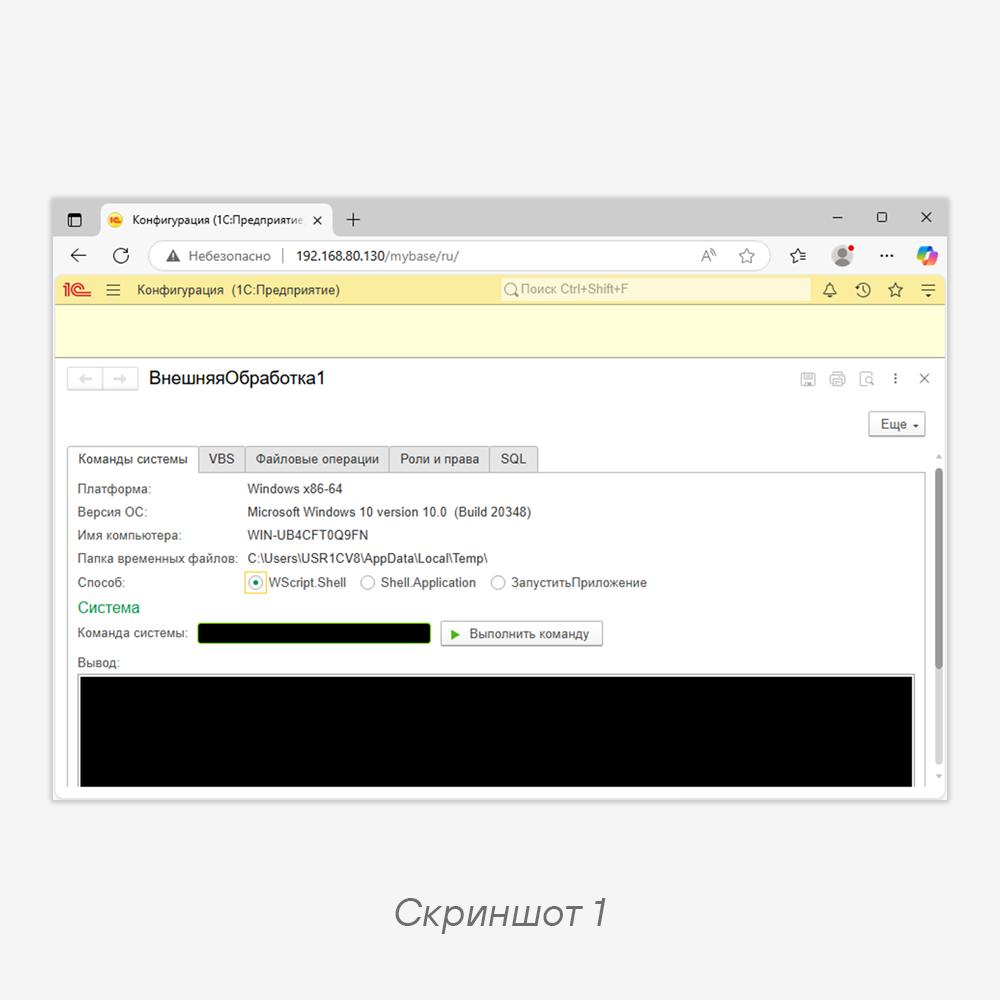
• First, if the information base is published on a web server, attackers can gain access to it and launch a shell through the web client (screenshot 1).
In this case, we can find useful information in the IIS logs, in particular — access to the information base and loading of an external data processor:
2025-06-17 13:15:20 192.168.80.130 GET /mybase/ - 80 - 192.168.80.129 Mozilla/5.0+(Windows+NT+10.0;+Win64;+x64)+AppleWebKit/537.36+(KHTML,+like+Gecko)+Chrome/137.0.0.0+Safari/537.36+Edg/137.0.0.0 - 200 0 0 2
Code language: plaintext (plaintext)
2025-06-17 13:18:55 192.168.80.130 GET /mybase/ru/e1cib/logForm cmd=elements&formId=urn:form:ext:0:ce244e8a-6d30-4e49-a244-c6d80d2ea085@n=%22%D0%92%D0%BD%D0%B5%D1%88%D0%BD%D1%8F%D1%8F%D0%9E%D0%B1%D1%80%D0%B0%D0%B1%D0%BE%D1%82%D0%BA%D0%B0.%D0%92%D0%BD%D0%B5%D1%88%D0%BD%D1%8F%D1%8F%D0%9E%D0%B1%D1%80%D0%B0%D0%B1%D0%BE%D1%82%D0%BA%D0%B01%22;v=%223bb1cd7e449b0540951594ef9f12fb6d00000000%22&altFormId=urn:form:ext:8:add30da0-7627-464c-b936-820f49ac3e75@n=%22%D0%92%D0%BD%D0%B5%D1%88%D0%BD%D1%8F%D1%8F%D0%9E%D0%B1%D1%80%D0%B0%D0%B1%D0%BE%D1%82%D0%BA%D0%B0.%D0%92%D0%BD%D0%B5%D1%88%D0%BD%D1%8F%D1%8F%D0%9E%D0%B1%D1%80%D0%B0%D0%B1%D0%BE%D1%82%D0%BA%D0%B01%22;v=%223bb1cd7e449b0540951594ef9f12fb6d00000000%22&sysver=8.3.18.1208&confver=3bb1cd7e449b0540951594ef9f12fb6d00000000&rolesId=0&clang=ru 80 - 192.168.80.129 Mozilla/5.0+(Windows+NT+10.0;+Win64;+x64)+AppleWebKit/537.36+(KHTML,+like+Gecko)+Chrome/137.0.0.0+Safari/537.36+Edg/137.0.0.0 http://192.168.80.130/mybase/ru/ 200 0 0 37
Code language: plaintext (plaintext)After decoding the URL of the request above, we will get a string that indicates interaction with an external data processor:
"ВнешняяОбработка.ВнешняяОбработка1";v="3bb1cd7e449b0540951594ef9f12fb6d00000000"
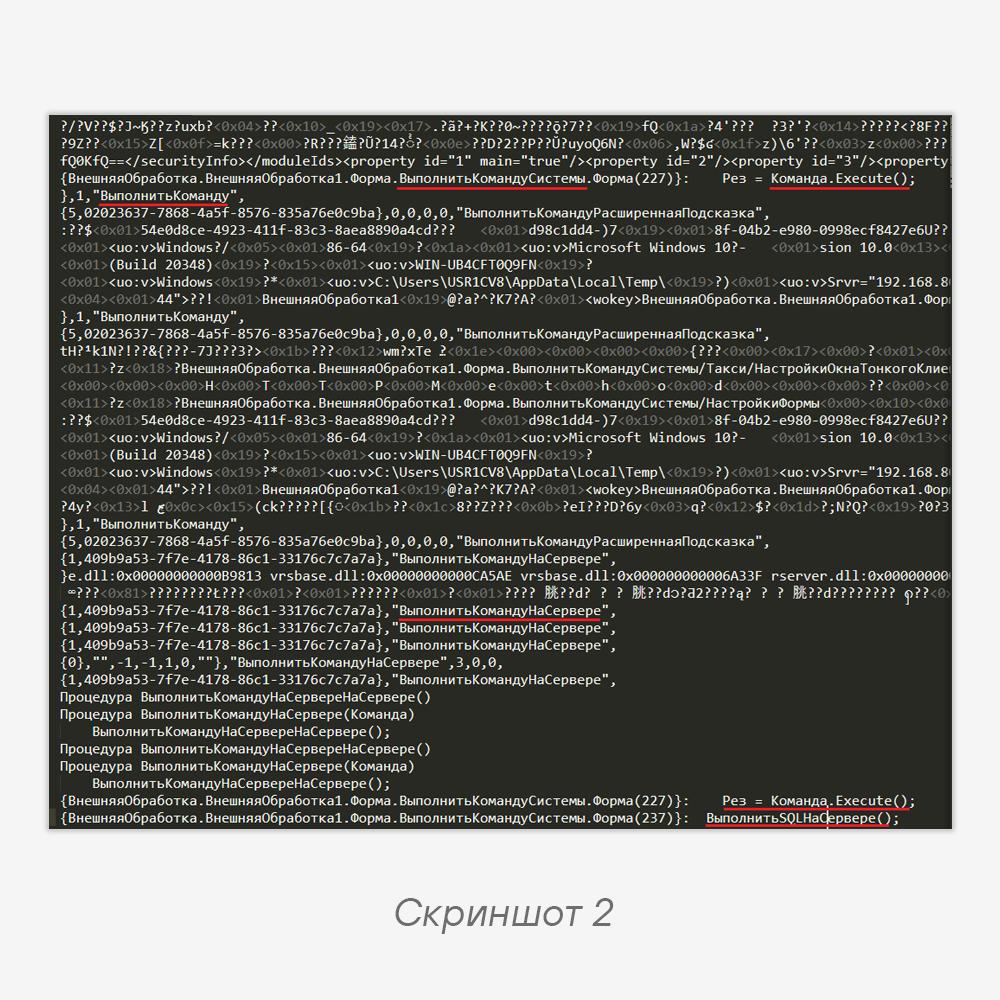
• Another way to detect traces of malicious activity is to analyze the rphost.exe process. If code is executed through 1C_shell, fragments of the external data processor’s code remain in the process memory (screenshot 2).
It is worth noting that this method will not yield results if the server or the rphost.exe process is restarted after the malicious code is executed.
#ir #detect #dfir #malware
@ptescalator
More from oUth0R
- We helped Apple fix a vulnerability in the kernel of its operating systems
We helped Apple fix a vulnerability in the kernel of its operating systems PT ESC expert…
- Recovering EVTX records: carving methods
Recovering EVTX records: carving methods 🧩 When investigating incidents where attackers encrypt virtual machine images, a…
- Operation Chewbacca
At the end of June, the PT ESC team, during incident investigations, discovered a new group…
- Your Zimbra server is at risk
Recently, our PT ESC IR team encountered a new attack by ransomware groups on Zimbra mail…
- He's not your gsocket
He's not gsocket to you 😑 During the investigation of one of the incidents, PT ESC…


More in Malware
- This is Siemens...
Recently, our colleagues from the Positive Industrial Expertise Center discovered a curious Windows sample on MalwareBazaar.…
- Anti-antivirus
Recently, we came across an APK with an intriguing and trust-inspiring name: «Антивирус ФСБ.apk». After installing…
- .exe .docm .xlsm
.exe .docm .xlsm Malicious files with these extensions are most often found in corporate network traffic.…
- Operation Chewbacca
At the end of June, the PT ESC team, during incident investigations, discovered a new group…
- Your Zimbra server is at risk
Recently, our PT ESC IR team encountered a new attack by ransomware groups on Zimbra mail…