
How to fix CFG
More in Reverse engineering
- Why IDA doesn't fold constants and how to fix it
Why IDA doesn't fold constants and how to fix it 👨💻 Recently, obfuscation has been increasingly…
- Recognize STL code easily
Recognizing STL code with ease 😐 During reverse engineering, we often encounter STL code whose analysis…
- Again CFG
CFG again 👋 A common task when extracting malware configurations at scale is obtaining function boundaries…
- Deobfuscating .NET function names manually
Deobfuscating .NET function names manually 🙌 .NET malware loves packers, obfuscation (of names, CFG, and other…
- Idea for a correlation rule in SIEM
Idea for a SIEM correlation rule 💡 Although tracking the entire attack chain described in the…

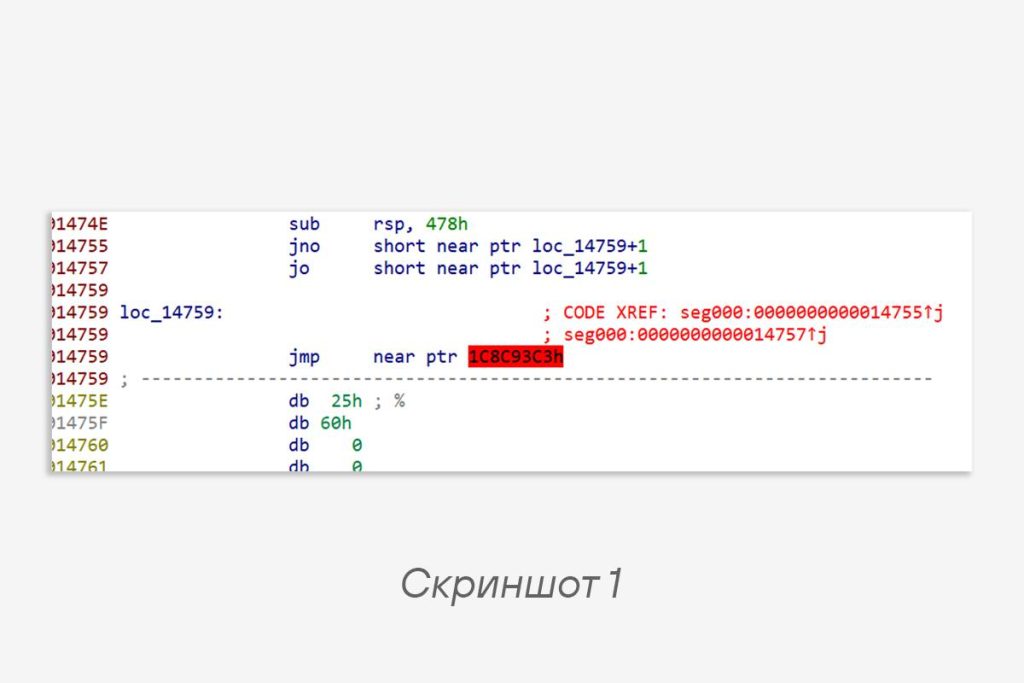
In the process of reverse engineering malware, we encounter cases where obfuscation hinders understanding the overall algorithm. One example is the creation of two consecutive opposite conditional jumps to a single point.
Schematically it looks like this:
start:
    jnX labelA
    jX labelA
labelA:
    <bytes>
Code language: YAML (yaml)
That is, when analyzing code, IDA first follows the
False branch and creates code there, deferring the True branch for later. Upon encountering the jnX instruction, IDA creates code immediately after the current one.Next, upon encountering the opposite conditional jump, it again follows the
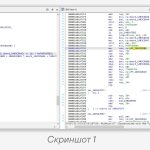
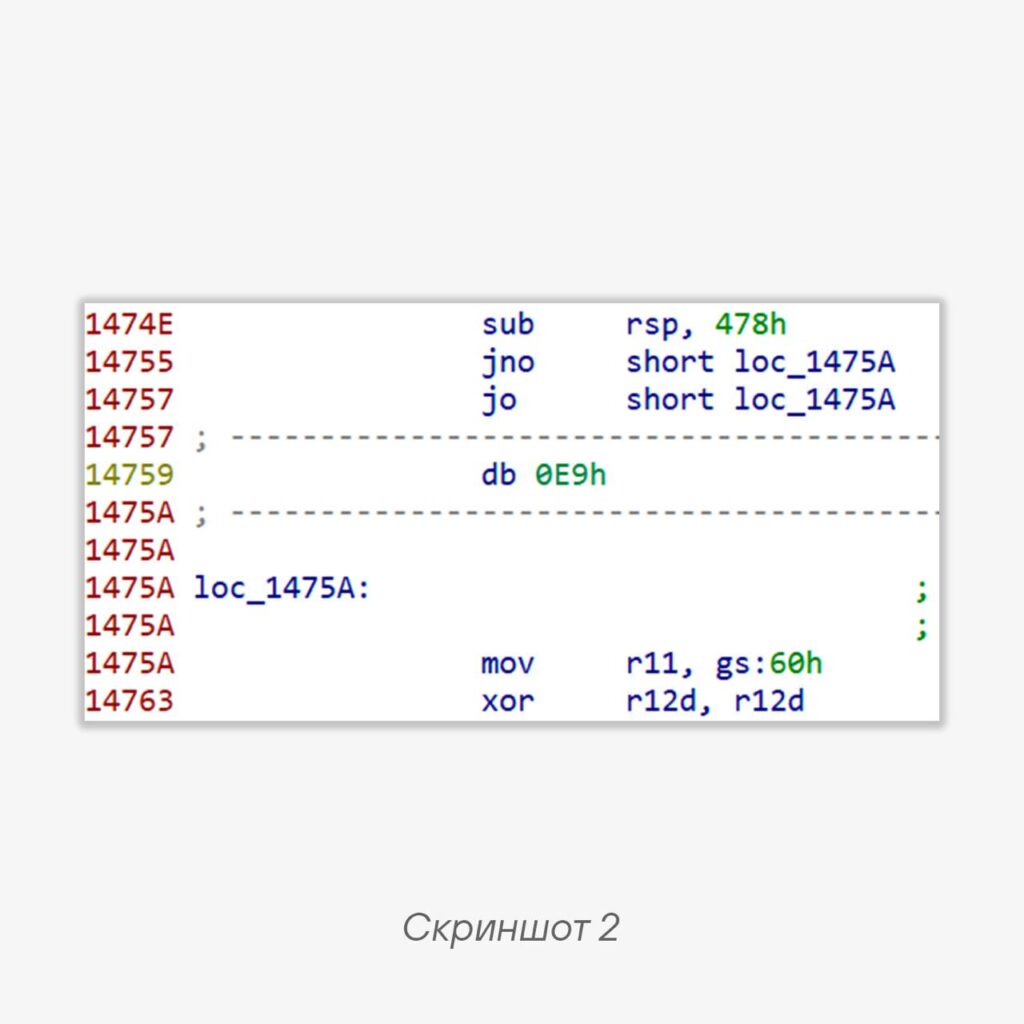
False branch and creates code at the next address, building a garbage instruction after which disassembly is no longer possible. Then IDA returns to the deferred queue and takes the address from there, but the trouble is that code has already been created there, which means analysis terminates (clearly visible in screenshot 1).During live execution, regardless of the flag state, the jump to the operand will be taken, meaning execution will proceed as in screenshot 2 if we correct the control flow.
The difficulty in researching such shellcodes is that there can be many jumps and each time the analysis will stumble on them. You can try to fix it manually, but what if there are hundreds of such blocks?
✍️ To handle this, let’s write a simple
IDAPython script that will fix the problem automatically. The task is to find these blocks and patch them.First, let’s compile a list of opposite conditional jumps and put it into a function that will compare two consecutive instructions against the list:
def c_jumps(addr, n_addr):
    ops = [
        ("jz", "jnz"),
        ("jnz", "jz"),
        ("je", "jne"),
        ("jne", "je"),
        ...
    ]
    if (ida_ua.print_insn_mnem(addr), ida_ua.print_insn_mnem(n_addr)) in ops:
        return True
    return False
Code language: Python (python)
We will sequentially iterate through each instruction until we find the ones we need or hit the limit.
def deobf(start, limit=BADADDR):
    while addr != BADADDR:
        n_addr = ida_search.find_code(addr, ida_search.SEARCH_DOWN)
        if n_addr == BADADDR:
            break

        if not c_jumps(addr, n_addr):
            addr = n_addr
            continue
Code language: Python (python)
🧐 Using the
find_code method from the ida_search module, we find the next address where code exists, and using the c_jumps function, we check whether the instructions at this and the next address are opposite jumps. Having found them, we need to check whether these jumps point to a single point (that is, whether their operands are equal):
o1 = get_operand_value(addr, 0)
o2 = get_operand_value(n_addr, 0)

if o1 != o2:
    addr = n_addr
    continue

insn = ida_ua.insn_t()
l1 = ida_ua.decode_insn(insn, addr)
l2 = ida_ua.decode_insn(insn, n_addr)
Code language: plaintext (plaintext)
Using
get_operand_value, we obtain the operand values (for jX and jXX it is one) and check their equality. To determine the length of the segment that needs to be patched, using decode_insn from ida_ua, we find the instruction lengths.Then we fix the conditional jumps and ask IDA to analyze the new code. This is necessary so that further obfuscation blocks can be found:
after_addr = n_addr + l2
ida_bytes.patch_bytes(addr, bytes([0x90] * (l1 + l2 + 1)))

ida_auto.auto_wait()
ida_bytes.del_items(after_addr, ida_bytes.DELIT_EXPAND)
ida_auto.auto_wait()

ida_ua.create_insn(o1)
addr = o1
ida_auto.auto_wait()
Code language: plaintext (plaintext)
🗂 Using the
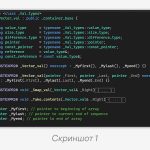
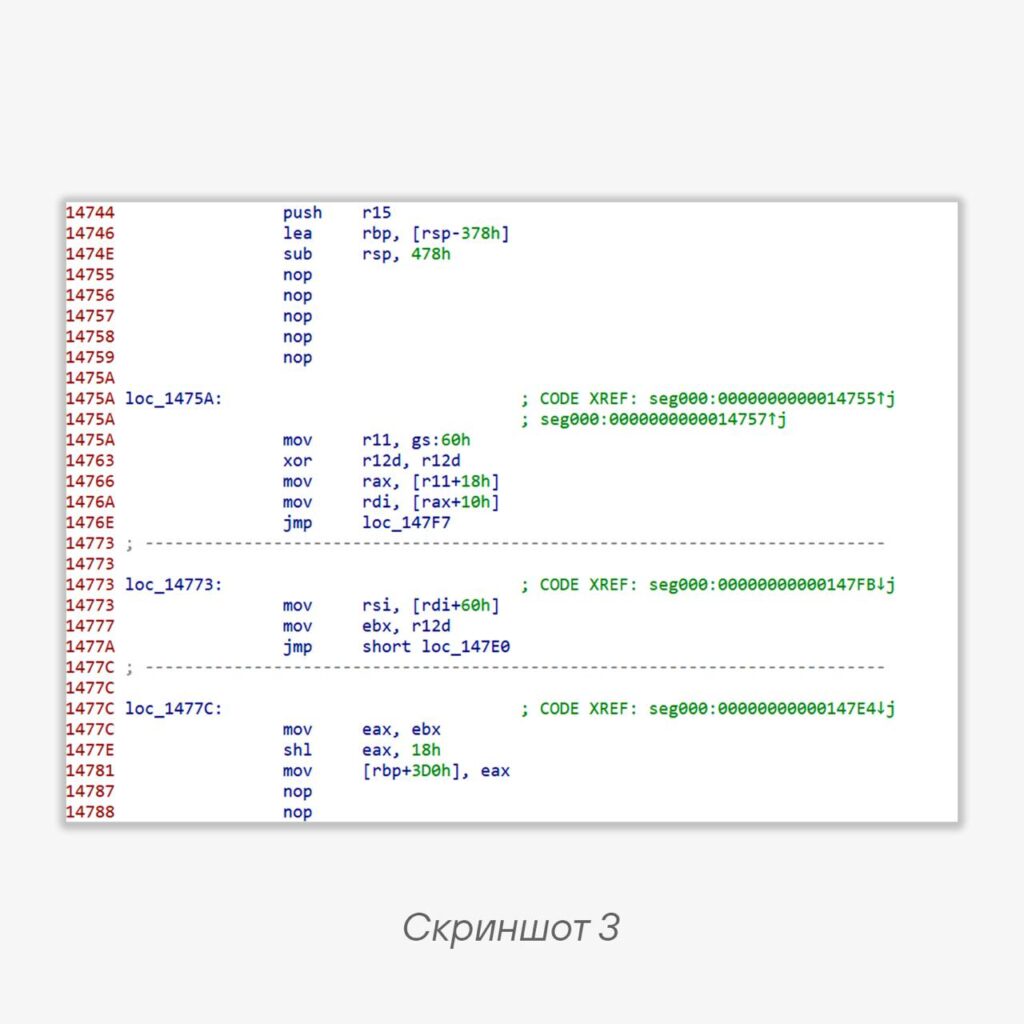
patch_bytes method from ida_bytes, we patch the instructions, with auto_wait from ida_auto we ask IDA to analyze the new code, then, using del_items, we delete the garbage instructions created during the initial analysis and analyze again. Using create_insn, we create a valid instruction where the conditional jumps pointed, and re-analyze one last time.Thus, this script allows obtaining normal ASM code from obfuscated code, as in screenshot 3.
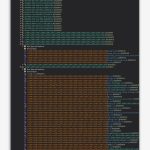
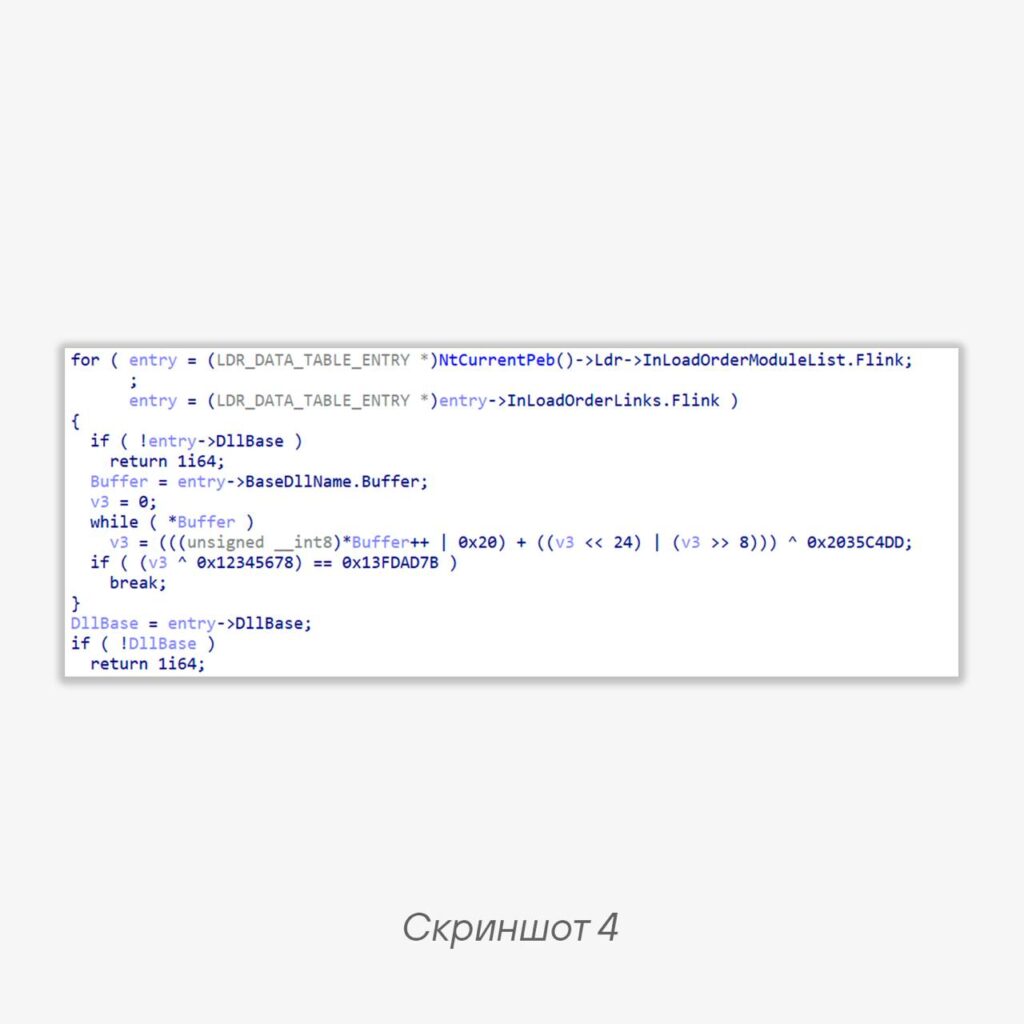
Sometimes after running it, isolated unrecognized bytes remain, but they are easy to fix. From this code, you can create a function, decompile it, and analyze it (as in screenshot 4).
Study IDAPython, write scripts. Happy reversing!
#tip #reverse #idapython
@ptescalator
More from global_author
- This is Siemens...
Recently, our colleagues from the Positive Industrial Expertise Center discovered a curious Windows sample on MalwareBazaar.…
- Anti-antivirus
Recently, we came across an APK with an intriguing and trust-inspiring name: «Антивирус ФСБ.apk». After installing…
- .exe .docm .xlsm
.exe .docm .xlsm Malicious files with these extensions are most often found in corporate network traffic.…
- Chaos, shock, private keys from a not-so-private GitLab 💻
Over the past couple of months, the attacker has been distributing trojans from several npm accounts:…
- ::%16777216 — so what exactly are you?
::%16777216 — so what exactly are you? It is known that during attacks, adversaries can use…




More in Reverse engineering
- Why IDA doesn't fold constants and how to fix it
Why IDA doesn't fold constants and how to fix it 👨💻 Recently, obfuscation has been increasingly…
- Recognize STL code easily
Recognizing STL code with ease 😐 During reverse engineering, we often encounter STL code whose analysis…
- Again CFG
CFG again 👋 A common task when extracting malware configurations at scale is obtaining function boundaries…
- Deobfuscating .NET function names manually
Deobfuscating .NET function names manually 🙌 .NET malware loves packers, obfuscation (of names, CFG, and other…
- Idea for a correlation rule in SIEM
Idea for a SIEM correlation rule 💡 Although tracking the entire attack chain described in the…